
Infrastructure Diaries - 2
The hard parts, literally.

I loved visiting a school in a village in western Odisha. A school amid greenery, trees on one side, open fields on another and low hills just beyond. Children played freely in the open space and learned from nature. Every visit to that school evoked a sense of openness and freedom. A few years later, I could not recognize the place. There was a 7 feet wall all around. The Head Teacher and Sarpanch showed me the wall and other new additions with much enthusiasm. An additional building (much needed), a kitchen garden, beautiful flower beds, and a flag pole on a raised platform - children now had very little space to play!
Another brick in the wall
Most projects do not have to concern themselves with compound walls. Samagra Shiksha (earlier Sarva Shiksha) does not budget for it, and the guidance is towards convergence, i.e. utilize resources from MGNREGA and explore others like MPLAD, MLA-LAD and CSR. I will not discuss issues like the availability of funds and land disputes today. But there is a larger question -Why do we need walls?
One of the schools I studied in had a low wall. It was easy to climb over it and bunk classes. The school’s solution was to raise the height. Our solutions became more creative. The wall became higher. Now, the school has a very high one with spikes on top. The school has solved the problem of keeping uninterested children inside.
A school had invested in a computer lab. There was a concern that the assets could be damaged or stolen, and teachers had a negative view of young people in the community. They built a wall. On the next visit, I saw broken bottles between the building and the back wall of the compound. People had started using it as a space for drinking in the evening.
“We don’t know what’s happening inside.” In some tribal areas, where trust is an important community value, people were suspicious of outsiders like teachers from other districts. Building a wall did not help in developing trust.
There is no single solution for a wall - it depends on the context. Are we in urban or rural areas? Does the area have a high crime rate? Is the school next to a highway? Some concerns are genuine and objective, based on facts and data, e.g. some areas have more harassment or child trafficking cases. Other perceptions emerge from deep-rooted biases, e.g., negative attitudes about Denotified Tribes (DNTs).
A wall creates a barrier between the school and the outside. This barrier can do many things. It can protect children and school infrastructure. It can alienate children from their natural surroundings. It can also isolate the community from the school, with them seeing it differently from themselves. If a physical wall is needed, more should be done to bring down the other invisible and metaphorical walls.
Walk this way
A rural school has a small ground where children play. The school was “beautified” and the ground was covered with interlocking paver blocks.
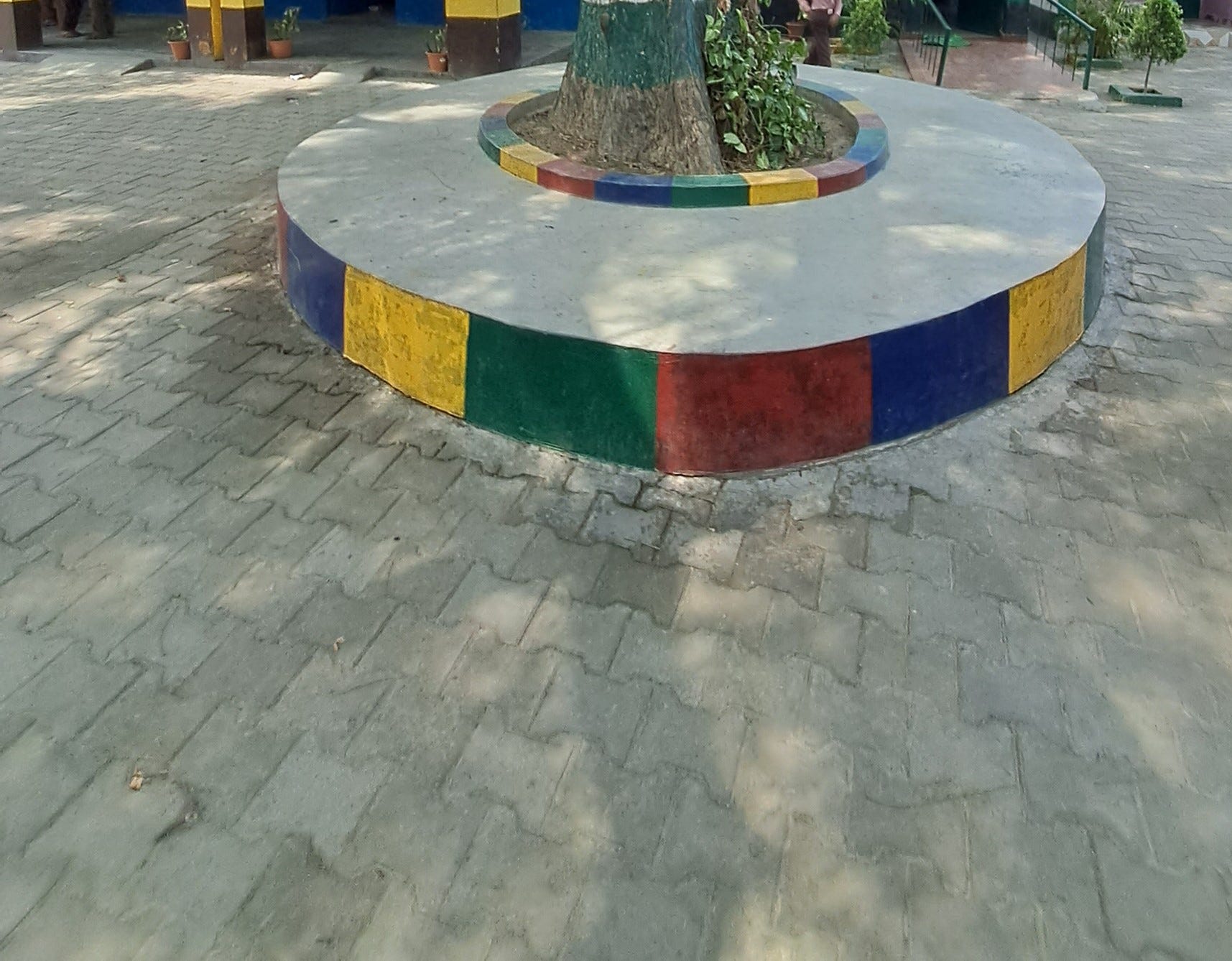
This picture is from another school. Though I like the concept of a चबूतरा (platform around the tree), in many places, it is too wide and takes more space away.
Pathways with paver blocks can help when it is rainy and the ground gets waterlogged or muddy. But do we need to cover more space with either blocks or concrete? When we played on natural surfaces, like soil or grass, we fell and hurt ourselves. But most of the time, we would dust ourselves off or stain minor wounds red with tincture iodine and continue playing. But running around and falling on concrete cannot be brushed off as easily! So, when I see a school covered with concrete or paver blocks, I see a school that does not encourage play.
Floor tiles are another popular addition. In the earlier school Kayakalp initiative, I saw several schools where they tiled every room and even the stairs. Cheap tiles that were slippery and chipped off, leading to sharp edges that could cut badly.
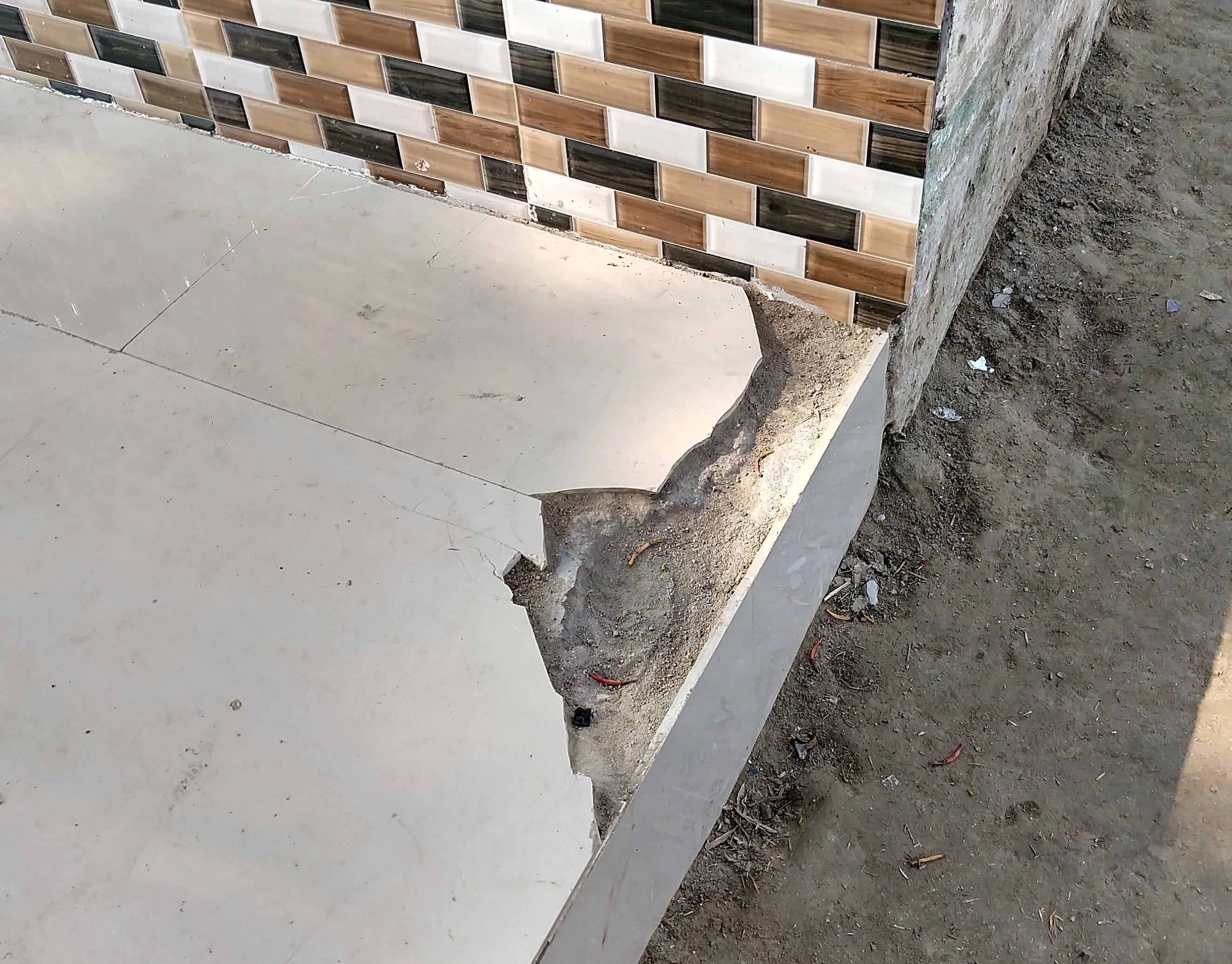
Many people prefer tiles as they are easier to procure and install, saving time and labour costs. But tiles, especially the cheaper options, are slippery and chip easily. Kota stone was a preferred option earlier - it is durable and not slippery. But unfortunately, un-shiny stone does not fit a भव्य (bhavya, grand and fancy) aesthetic.
The roof is leaking
Seepage is probably the most recurring problem I have seen in schools. Lipa-poti (literally, whitewashing) conveniently hides it. One project paints the walls; the next monsoon, we see the same issue coming up; and the year after, another project will repaint it, this time with a new logo.
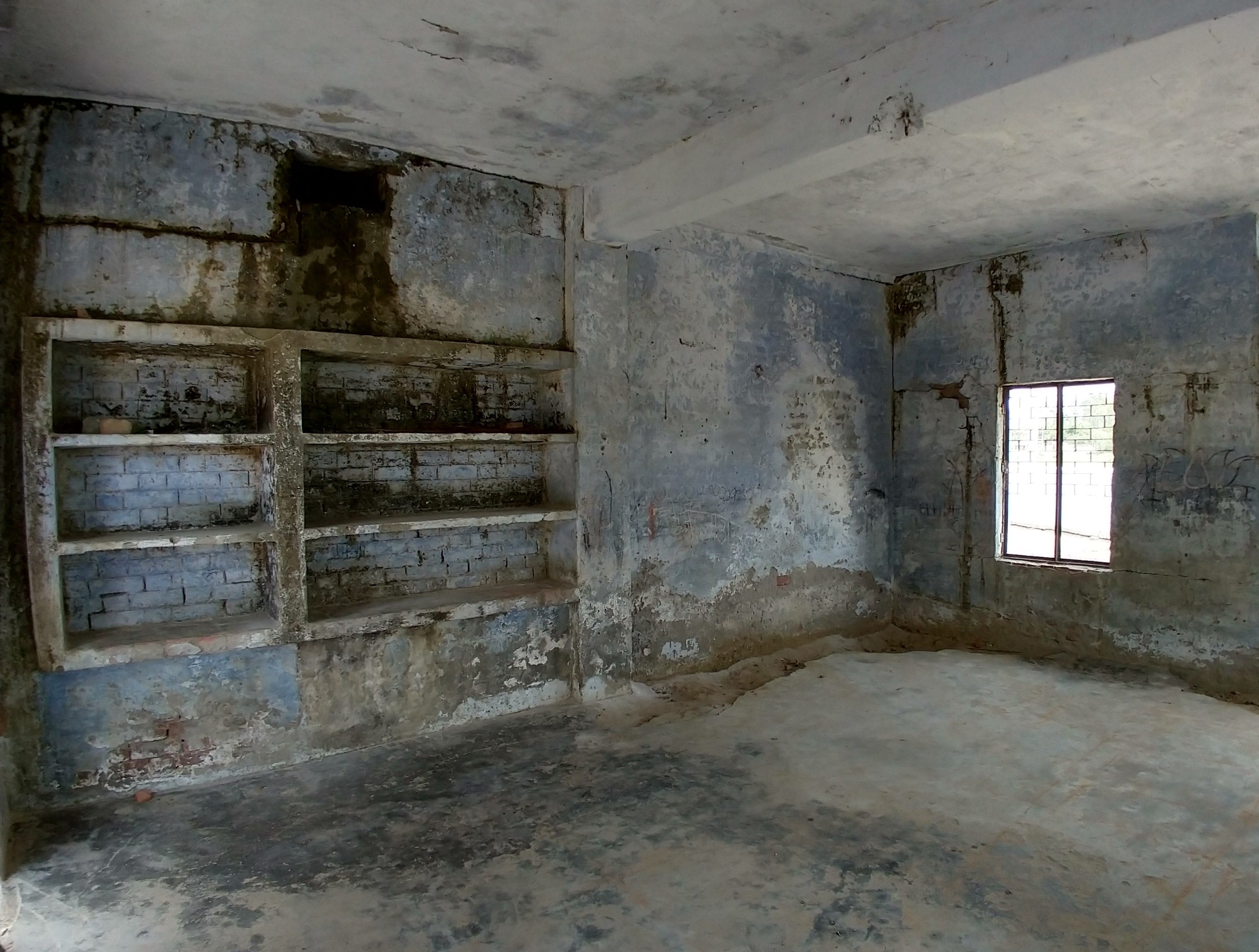
This 'before' photo shows the damage over time due to seepage.
The underlying issue is always the roof. The resulting water damage can also damage the learning materials inside. There are two easy, though more involved, solutions.
Waterproofing the roof – Seems obvious!
The slope of the roof - A slight slant ensures that rainwater does not accumulate. If you see a waterfall in front of the classroom door, the roof is slanting, but the wrong way! Water should ideally drain away from the main entrance.
Many schools and Anganwadis, especially in rainy areas, have slanting roofs. Corrugated sheets, if not fitted properly or without adequate overhang, also allow rainwater to come inside. One concerning aspect is the continued use of asbestos cement (AC) sheets for roofing. While WHO notes that all types of asbestos cause cancer, the Government of India does not prohibit its use, and we continue to import chrysotile – a kind of asbestos used in AC roofing.
In the end… it matters.
It is unlikely that many NGOs will be involved in building walls and roofs and have to understand the what and how of plinth protection, asbestos, slopes etc. But if anyone asks, or you are part of a conversation where this comes up, even if you are not an engineer, share some points with stakeholders to think about -
Children should feel they are in a school, not a jail.
There is no need for a 7-foot compound wall; those who want to climb a wall find a way.
Children should be safe and not get hurt because of built environments.
Walls should be built well and should not collapse even in heavy rains.
Barbed wire boundaries at the ground level can hurt children and animals. Explore green fencing alternatives like bamboo lattices and plants.
Floor surfaces should not be slippery; if using tiles, use anti-skid options.
Children should have spaces for play.
We have limited space for playgrounds, especially in urban areas. Let us not pave them over. ऊबड़-खाबड़ ज़मीन को समतल बनाना काफ़ी है। Remove stones and make the surface even.
Children should have opportunities to learn from their surroundings.
Use walls and pavers for learning. Walls with jaali patterns, paver blocks set with interesting patterns, or painted with numbers or shapes for games.
Taking a cue from this, in the next article, we explore learning infrastructure inside the classroom.
Readings and references
Samagra Shiksha – Framework for Implementation 2022 – Ministry of Education, Government of India
Singh R, Frank AL. Analysis of the Indian Government's position on the use of asbestos and its health effects. Public Health Action. 2023 Jun 21;13(2):50-52. doi: 10.5588/pha.23.0013. PMID: 37359063; PMCID: PMC10290263.
I find this series really interesting. Thank you for sharing your observations and insights with all of us in such a crisp manner.
Lovely, thought-proking read. Thank you.